
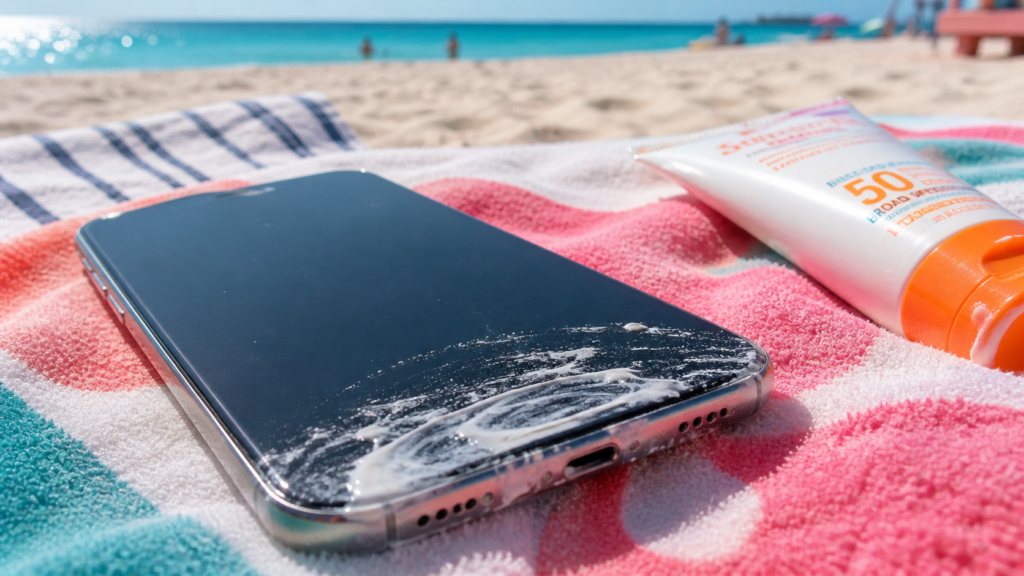
Sunscreen damage to phone hardware is something most Miami users discover too late — not at the beach, but weeks later, when a charging port stops making reliable contact or a speaker goes muffled and nobody connects it back to that Saturday afternoon at South Beach.
It looks harmless. The phone sits on a towel while its owner reapplies SPF 50. A friend picks it up with lotion-coated hands. A sunscreen spray cloud drifts over while someone else is applying. By the time anyone notices a problem, the damage is already chemical, already progressing, and in most cases already beyond what wiping the screen can fix.
Sunscreen damage to phone devices is one of the most consistent patterns we see at We Go We Fix every summer. This guide breaks down exactly where and why it happens — across five specific components — and what Miami users can actually do to stop it before it becomes a repair bill.
Section 1: Why Sunscreen Is More Dangerous to Electronics Than Most People Realize {#section1}
Most people think of sunscreen damage to phone screens as purely cosmetic — a greasy smear, maybe a smudge that takes extra effort to clean. That part is real. However, the deeper issue is chemical, and it starts at the molecular level.
Modern sunscreens fall into two types. Chemical sunscreens — the sprays and lotions that absorb invisibly into skin — use active compounds like avobenzone, oxybenzone, and octinoxate. These compounds are oil-soluble and highly penetrating by design, which is what makes them effective on skin. It also makes them effective at seeping into the seams, port openings, speaker meshes, and button gaps on your phone. The Environmental Working Group’s Sunscreen Database has documented the penetrating behavior of these compounds extensively.
Mineral sunscreens — those containing zinc oxide or titanium dioxide — work differently. They sit on the skin’s surface and reflect UV light. Because they are physically dense, they clog rather than penetrate. On a phone, they leave a white residue that packs into mesh grilles and connector openings and hardens as it dries.
Miami’s heat makes everything worse. A phone left on a beach towel in July can reach surface temperatures of 115 to 130 degrees Fahrenheit in direct sun. At those temperatures, chemical sunscreen compounds become more fluid and more reactive. They spread faster, penetrate deeper, and interact more aggressively with adhesives, polymers, and display coatings inside the device. We have documented what Miami’s ambient heat alone does to internal components in our breakdown of why overheating logic boards require micro-soldering to repair. Add sunscreen chemistry to that heat, and the damage compounds in ways that are genuinely difficult to reverse.
Section 2: 5 Ways Sunscreen Damage to Phone Components Happens {#section2}
Understanding which components are affected — and how — helps explain why sunscreen damage to phone devices is not a cosmetic problem and cannot always be resolved with a cleaning cloth.
1. The Oleophobic Screen Coating Degrades
The glossy, fingerprint-resistant surface on your phone display is protected by an oleophobic coating — a thin layer of fluoropolymer applied at the factory. This coating is what makes the screen easy to swipe and simple to wipe clean. Chemical sunscreen compounds, particularly oxybenzone-based formulas, are oleophilic — they bind to oil-adjacent surfaces. Repeated exposure strips this coating unevenly, leaving patches that look permanently cloudy, attract fingerprints aggressively, and eventually develop a visible haze at certain viewing angles. The factory coating cannot be reapplied at home. Once it degrades significantly, professional resurfacing or screen replacement is the only solution.
2. The Charging Port Corrodes
This is where the most consequential sunscreen damage to phone hardware occurs. The USB-C or Lightning port is an open channel directly into the device. Aerosol sprays can drift into the port during application. Lotion rests against the port edge during casual holding. Once inside, mineral sunscreen compounds dry and compact into the metal contact area. Chemical compounds initiate a low-grade electrochemical corrosion process that worsens with every charge cycle and humidity exposure.
The result is a port that charges intermittently, then slowly, then stops making reliable contact. Most users assume the cable is at fault — by the time they arrive at a repair shop, the contacts are pitted or coated with oxidized residue. This is the same corrosion mechanism we documented in our guide on how Miami’s salt air corrodes phone motherboards without the device ever touching water, triggered here by a different chemical source.
3. Speaker and Microphone Grilles Become Clogged
Your phone’s speaker grille uses fine mesh to let sound out while blocking debris. It is not built to resist sunscreen. Mineral-based formulas — zinc oxide especially — pack into speaker meshes with a density similar to fine clay. As it dries in Miami’s heat, it hardens. Call audio becomes muffled. Speaker output drops. The earpiece used during phone calls is particularly vulnerable because it sits at the top of the device and is difficult to inspect without a flashlight.
In mild cases, ultrasonic cleaning at a professional shop can restore function. In more advanced cases where hardened residue has pushed past the mesh into the driver housing, the speaker component needs replacement.
4. Side Button Seals Break Down
Physical buttons on modern phones use rubber gaskets to maintain their water-resistance seal. These gaskets are designed for liquid intrusion — not sustained chemical exposure. Repeated contact with sunscreen, especially spray formulas that work under the button edge, degrades the rubber and breaks down the adhesive bond that holds the gasket in place. The first symptom is a button that feels slightly tacky or requires harder pressure. The second is a button that clicks but does not register reliably. The third — if ignored long enough — is a button that stays depressed and does not return.
5. Compromised Seals Let Miami Humidity In
This is the damage most users never connect back to sunscreen. Modern phones carry IP water-resistance ratings based on the integrity of their factory seals. Once sunscreen compounds degrade the gaskets around ports and buttons, that seal rating becomes meaningless. The device is now open to Miami’s ambient humidity in ways it was not before. As we covered in our guide on the microscopic beach sand damage Miami repair shops see every summer, once the outer protective seals fail, humidity and fine particles begin their own separate damage cycle on the internal board.
Section 3: How to Protect Your Phone During Miami Beach Season {#section3}
You are not going to leave your phone at home, and you should not have to. However, a few consistent habits dramatically reduce the risk of sunscreen damage to phone hardware throughout the season.
Apply sunscreen before touching your phone. The window between applying lotion and the moment it absorbs into skin is the highest-risk period. Handle the device before you apply, not after.
Never spray sunscreen within three feet of your phone. Aerosol sunscreen drifts well beyond the immediate application area and settles on nearby surfaces, including open ports, before it is visible to the eye. Store the phone away before any spray sunscreen is used nearby.
Use a sealed dry bag at the beach. Waterproof pouches serve a double purpose in Miami: they block ocean spray and they create a physical barrier against sunscreen contact. They are inexpensive, reusable, and preventive. Port corrosion repair is not.
Clean the charging port every two to three weeks during beach season. A soft, dry toothbrush used gently across the port opening removes accumulating residue before it hardens. Do not use high-pressure compressed air directed into the port — it can push loose particles deeper into the housing.
Wipe the screen with a microfiber cloth after beach exposure, not paper towels. Paper towels are mildly abrasive on oleophobic coatings and accelerate their degradation. A dry microfiber cloth removes chemical residue gently and extends the coating’s effective life.
Address port issues early. A simple port cleaning at a repair shop is a fraction of the cost of a board-level repair when corrosion spreads to the connector’s solder points. The longer corrosion sits, the deeper it travels. Our commitment to careful, privacy-respecting handling of every device we inspect is described in our guide to professional repair standards and data privacy.
Section 4: Conclusion and Final Thoughts {#section4}
Sunscreen damage to phone hardware does not announce itself with a crack or a splash. It announces itself quietly — a port that charges a little slower, a speaker that sounds a little muffled, a screen that never quite wipes clean. By the time most Miami users make the connection between beach days and device problems, the damage is weeks or months old.
Protecting your phone does not require changing your lifestyle. Apply before you touch, store before you spray, and clean early and consistently. If the damage is already done, address it sooner rather than later — chemical corrosion does not wait.
FAQs
Can sunscreen really cause permanent damage to a phone, or is it just surface-level?
It can cause both surface and structural damage. Chemical sunscreen compounds strip oleophobic screen coatings and corrode charging port contacts. Mineral formulas pack into speaker meshes and harden. Neither effect is cosmetic once it progresses past the early stage.
My charging port stopped working after a beach trip. Could sunscreen be the cause?
Yes, especially if aerosol spray was used nearby. Port contact corrosion from chemical or mineral sunscreen residue is one of the most consistent beach-related repair cases seen in Miami during summer months.
My phone is IP68 water-resistant. Does that protect it from sunscreen chemicals?
No. IP68 ratings cover water intrusion under specific controlled test conditions. They do not cover chemical resistance. Additionally, repeated sunscreen exposure can degrade the rubber gaskets that create the water seal, ultimately reducing the device’s water resistance as well.
Will wiping my phone down after the beach prevent this damage?
Surface wiping helps reduce accumulation on the screen. However, compounds that have already entered the charging port, speaker mesh, or button seams are not removed by surface wiping. Regular professional cleaning throughout beach season is more effective for preventing internal buildup.
Is there any way to restore the oleophobic screen coating at home?
No reliable home solution exists for restoring factory oleophobic coatings once they have been stripped. Some third-party sprays claim to reapply the coating, but they do not match the durability or performance of the original. Professional screen resurfacing or replacement is the effective solution.